
The professional football franchise known for more than 85 years as the Washington Redskins has undergone a historic transformation over the past few years.
A combination of cultural shifts, poor management, and a damaging NFL-led sexual harassment investigation has left what was once one of the pro football’s proudest franchises into an organization searching for a new identity and a stable long-term direction, while heading into a most uncertain future.
After dropping the Redskins name and logo following the 2019 season and rebranding as the Commanders, the franchise that won three Super Bowls from the 1982 to 1991 seasons has now gone 16 years without a single playoff win. Owner Dan Snyder has been the central source of fan anger and resentment for most of his two decades of ownership of the franchise, and he’s recently expressed publicly that he may be ready to sell the Commanders, with a price tag that could exceed $6 billion.
Amazon owner Jeff Bezos and rapper Jay-Z, along with actor and avowed Commanders fan Matthew McConaughey, have initiated a joint bid to purchase the Washington NFL franchise, according to multiple media reports. Forbes recently reported that there are at least four legitimate bidders for the Commanders, with Snyder employing Bank of America to broker the transaction.
For nearly a year, Mark Moseley Jr., the son of former Redskins star place kicker Mark Moseley Sr., has been publicly advocating for the purchase of the Commanders by Bezos, Jay-Z and McConaughey. Moseley Jr., who works in IT in the suburban Washington, D.C., area and is a Commanders fan, posts daily on his Twitter feed about his desire to see the trio of celebrities take over the franchise — even declaring his willingness to help assemble a transition team.
Moseley Jr. caught some viral attention on social media in late October, as he posted photos of his father’s lanyard from the Commanders’ 90th anniversary Homecoming celebration. In a shocking oversight, the Commanders misspelled the name “Moseley,” leaving out an “e” to spell “Mosley.”
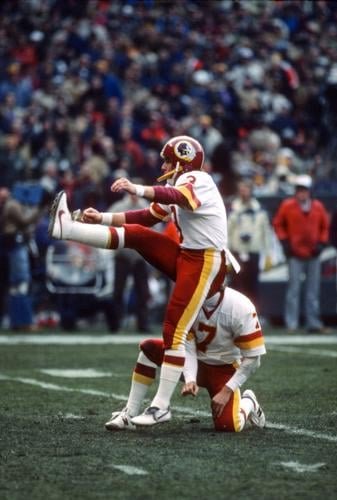
Moseley’s father, Mark Moseley Sr., is Washington, D.C., football royalty. Moseley was one of the last “straight on” place kickers in the National Football League — kickers who lined up directly behind the football and kicked it in a straight line, as opposed to today’s angled soccer-style approach. By 1982, the year he helped lead the Redskins to their first Super Bowl championship, Moseley was the only straight-on kicker left in the NFL.
Moseley successfully converted two field goals and three extra points as the Redskins defeated the Miami Dolphins 27-17 in Super Bowl XVII for the franchise’s first NFL championship in 40 years. By the time Moseley left the Redskins midway through the 1986 season, after a dozen years with the franchise, he was Washington’s all-time leading scorer. More than three and a half decades later, Moseley remains Washington’s all-time leading scorer, with over 1,200 points.
After his playing career ended, Moseley became a successful entrepreneur, owning multiple restaurants in the greater Washington, D.C., area and working in franchising with Five Guys Burgers and Fries, helping the company achieve massive growth over the past couple decades.
For many, the misspelling of the franchise’s all-time leading scorer on his lanyard at the team’s 90th anniversary Homecoming celebration was just another sad example of a franchise that has lost its way. But for true old-time fans of Washington, D.C., professional football, the last couple decades have been nothing new, as the franchise has experienced a roller coaster of highs and lows over the last 90 years.
After a 4-4-2 result in 1932 — the franchise’s first in the National Football League — the Boston Braves changed their name to the Boston Redskins heading into their second season in 1933. The Redskins were mediocre during their five years in Beantown, with three .500 seasons and a 2-8-1 season in 1935. But in 1936 the franchise’s fortunes rapidly turned, as the Redskins went 7-5 and stunned football observers by reaching the NFL Championship Game. The Redskins’ dramatic improvement in 1936 led up to the team’s move to Washington, D.C., prior to the 1937 season. Also prior to the 1937 season, the Redskins drafted a quarterback and punter from TCU named Sammy Baugh.
Slingin’ Sammy, as he came to be known, would be Washington’s quarterback for the next decade and a half, becoming the first face of the franchise and leading the Redskins to NFL Championships in 1937 and 1942, and appearances in the NFL Championship Game in 1940, 1943 and 1945. After World War II, however, the Redskins went into an extended funk that lasted for a quarter-century. The back end of Baugh’s Hall of Fame career lacked the big wins of his early years, as the Redskins posted only one winning season over Baugh’s final six seasons in the NFL from 1946 to 1951.
Following a surprising 8-4 season under head coach Joe Kuharich in 1955, the Redskins went 13 years without a winning season until the legendary Vince Lombardi — coaxed out of retirement following five World Championships with the Green Bay Packers — led the Redskins to a 7-5-2 mark in 1969. Tragically, it would be Lombardi’s only season at the helm of the Redskins, as the future Hall of Famer died of colon cancer prior to the 1970 season.
Lombardi’s death preceded the remarkable rebirth of the Redskins under George Allen, leading up to an appearance in Super Bowl VII by Allen’s unforgettable “Over the Hill Gang” of Billy Kilmer, Charley Taylor, Jack Pardee and Larry Brown. Allen led the Redskins to seven straight winning seasons from 1971 to 1977, including four 10-win seasons and five NFC playoff appearances, before giving way to one of his former players, Jack Pardee. The Redskins were a so-so bunch under Pardee in the late 1970s and early 1980s, leading up to Gibbs’ arrival in 1981.
The 1980s and the early 1990s were the best of times for professional football in Washington, D.C., as the Redskins became the toast of both the town and the National Football League.
Fans of a certain age will never forget John Riggins running over Miami Dolphins cornerback Don McNeal on the legendary “70 Chip” play, resulting in a 43-yard touchdown run in the fourth quarter that gave the Redskins the lead in Super Bowl XVII. Running behind the legendary “Hogs” — Russ Grimm, Joe Jacoby, Fred Dean, Jeff Bostic and Mark May — Riggins set a Super Bowl rushing record as he helped push the Redskins past the Dolphins at the Rose Bowl in California.
Following the Redskins’ victory in Super Bowl XVII following the strike-shortened 1982 regular season, the 1983 Redskins were one of the most dominant teams in pro football history, setting offensive records that are today overshadowed by the team’s blowout loss at the hands of Marcus Allen and the Los Angeles Raiders in Super Bowl XVIII. Allen broke Riggins’ one-year old Super Bowl rushing record, but it wouldn’t be long before another Redskin held that distinction.
Washington remained one of the NFL’s marquee franchises throughout the mid-1980s until they once again reached the pinnacle, riding the arm of Doug Williams, the hands of Art Monk and Ricky Sanders, and the legs of little-known running back Timmy Smith to a blowout victory over John Elway and the Denver Broncos in Super Bowl XXII in January 1988. Smith set a new Super Bowl rushing record — which still stands — with 204 yards in his first career start, while Williams earned MVP honors with 340 passing yards and four touchdown passes.
Four years later came another Super Bowl title, as MVP quarterback Mark Rypien guided the Redskins to the greatest season in franchise history — a 17-2 masterpiece that culminated in a victory over the Buffalo Bills in the Minneapolis Metrodome in Super Bowl XXVI.
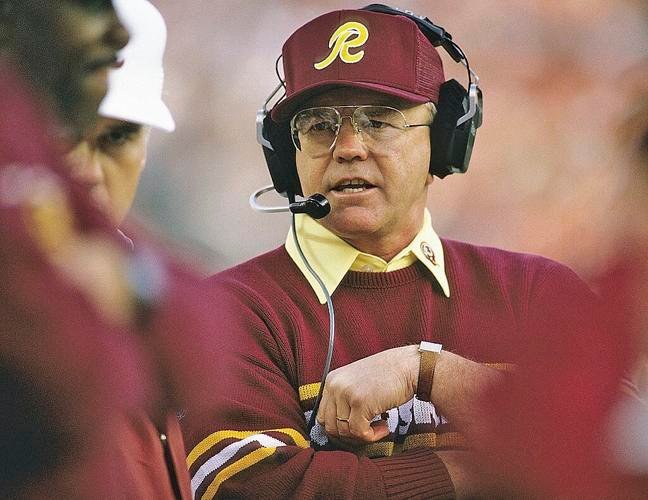
Many will mark the slow demise of the Washington, D.C., NFL franchise’s start happening on March 5, 1993. That was the day that longtime head coach Joe Gibbs retired after three Super Bowl championships in a decade with the Redskins. The franchise went into an immediate tailspin, starting with the disastrous 4-12 season under Richie Petitbon in 1993. After a rough decade under Norv Turner, Marty Schottenheimer, and Steve Spurrier, which saw Washington make the playoffs only once from 1994 to 2003, Gibbs returned to the sidelines for the 2004 season.
In his second stint in the nation’s capital, Gibbs got the Redskins to the playoffs twice in 2005 and 2007, and even managed to win the franchise’s last playoff game in 2005. But Gibbs was unable to revive the franchises’s big game magic of the 1980s and early 1990s, failing to get the team back to the Super Bowl.
Over the last 15 years, despite the presence of previous Super Bowl-winning head coaches, including Mike Shanahan and Jon Gruden, Washington has been a perennial underachiever, with only three postseason appearances and no playoff wins dating back to 2008. Over the last 30 years since Gibbs left the franchise the first time, Washington has posted only eight winning seasons and just six playoff appearances, with no Super Bowl or NFC Championship Game appearances. After winning at least 10 games eight out of nine seasons under Gibbs from 1983 to 1991, the franchise has had just three 10-win seasons in the ensuing 30 years.
The decline of the Washington NFL franchise certainly didn’t happen overnight. But with the possibility of Daniel Snyder selling the organization comes hope on the part of many Commanders fans that the future can be significant brighter than the recent past.
Snyder’s era in Washington, which began in 1999, has been plagued with every type of problem imaginable, from underachievement and heartbreak on the field to scandal, tragedy and controversy off the field.
To be fair, not everything has been Snyder’s fault. The Washington franchise has seemingly been cursed over the past several years with a wide array of strange and tragic setbacks.
The tragic murder of standout defensive back Sean Taylor at the hands of home intruders in fall 2007 seemed to be a turning point from which the franchise has struggled to recover. Taylor was one of the team’s shining stars — a hero to local fans who had emerged into the lynchpin of the Washington defense and a potential future Hall of Famer. The franchise simply hasn’t been the same since that horrible night Taylor was murdered.
There was a flicker of hope in 2012 after the Redskins drafted Robert Griffin III, but the franchise’s major long-term gamble — trading away numerous future draft picks to the Rams — proved costly after Griffin went down to a major knee injury in the Redskins’ NFC Playoff loss that winter to the Seattle Seahawks. Plagued by injuries and inconsistent performance, Griffin was out of Washington by 2016.
More recently, current Commanders head coach Ron Rivera worked through a cancer diagnosis to help the franchise reach the playoffs in 2020, while in 2021 defensive end Montez Sweat dealt with the murder of his brother, and earlier this year safety Deshazor Everett was charged with involuntary manslaughter following a Dec. 23, 2021, car crash that killed his girlfriend.
But in so many other ways, the decline of the Washington NFL franchise can be laid directly at Snyder’s feet.
When he first came to the Redskins, he thought he could simply buy a Super Bowl championship, as he signed aging high-priced free agents such as Deion Sanders and Bruce Smith, hopeful to give them one more shot at Super Bowl glory. But the gambit failed, leaving the Redskins largely devoid of talent as the older players aged out of the organization.
The coaching carousel of the Redskins/Commanders under Snyder has been notable, as the franchise has had no less than 10 head coaches under his ownership. Most of them had reached tremendous heights elsewhere, with Turner, Gruden, Shanahan and Rivera all reaching Super Bowls as head or assistant coaches with other NFL teams, and Steve Spurrier winning a college football national title at the University of Florida prior to his arrival in Washington. But the Washington job proved to be the one universal place for many of them where things didn’t go as planned.
The battle over the naming of the franchise was an unnecessary distraction for the team off the field throughout the last decade, and the more recent damaging allegations of sexual assault and a toxic workplace permeating throughout the Commanders organization not only cost Jon Gruden his job with the Oakland Raiders, but may also wind up contributing significantly to Snyder’s departure as team owner.
The allegations against Snyder are condemning — everything from sexual harassment to offers of seven-figure sums of money to victims in exchange for their silence. One woman claims that Snyder sexually assaulted her back in 2009, while another allegation stems around some inappropriate touching of a former Washington cheerleader.
The franchise was fined $10 million by the NFL in the summer of 2021 following an investigation into the team’s toxic workplace environment, leading to the day-to-day operations of the Commanders being briefly handed over to Snyder’s wife, Tanya.
The bottom line is that for all his success in business, Daniel Snyder’s ownership of the Washington NFL franchise has been an unmitigated disaster on the field. The franchise itself will prove to be a huge business success for Snyder and his family, as he figures to see a return anywhere from six to ten times his initial $800 purchase of the franchise back in 1999. Snyder will get to add still more billions to his existing billions.
But for those Commander fans eager for a return to the glory days — eager to a return to dominance on the field, as well as normalcy off the field — this is a time of cautious excitement. If the franchise were to move in a new direction with a new owner, it would give new hope to a franchise that has been devoid of hope for much of the last three decades.

Commented
Sorry, there are no recent results for popular commented articles.